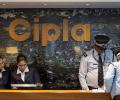
Drug major Cipla on Tuesday said it has launched drone-powered deliveries of critical medicines - cardiac, respiratory and other essential chronic therapies - to hospitals and pharmacies across Himachal Pradesh in partnership with Skype Air Mobility, a Gurugram-based drone delivery company. Cipla is the first among large Indian pharmaceutical companies to adopt drone-based deliveries to facilitate expedited supply to stockists in remote areas, it claimed. The Mumbai-based firm said the use of drones will support the on-time delivery of its medicines to chemists and clinics in remote areas, and minimise risks of affecting cold chain products due to temperature excursions.

The Tata Group and three other top business houses have joined hands with the Jharkhand government to ensure medical treatment to the state's below poverty line population.
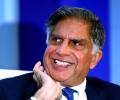
Ratan Tata has invested his own money into 3 high-growth online retail firms, which are yet to make a profit.

'The deal pipeline across products is robust for 2024.'
Among the Sensex firms, Axis Bank, Power Grid, Maruti, State Bank of India, Tata Motors, ITC, Nestle and Mahindra & Mahindra were the major gainers. Bajaj Finance and Larsen & Toubro were the laggards.
Takes to the sea to save whale sharks off the Gujarat coast from being hunted to extinction.
A goalless draw with Kolkata Port Trust in their concluding quarter-final league match ensured them a berth.

Pichai wants to get a billion Indians online.

Indian IT services companies have seen several CEO changes that have, over the past few months, led to some crucial exits at the mid-senior level in a trend that is likely to continue. According to a recent Motilal Oswal report, "Movement of mid-to-senior leadership at IT services firms is a reality, partially on account of multiple CEO-level changes.
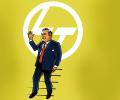
At the annual general meeting (AGM) of Larsen & Toubro (L&T) on Wednesday, shareholders made the usual request to the top management for bonus shares. But this time, the setting was different. The man at the helm, outgoing group chairman AM Naik, 82, was heard assuring shareholders that he would join the chorus soon. There were laughs and chuckles at Naik's playful remark as he addressed the last AGM, nearly six decades after he joined L&T as a junior engineer and some 25 years at the top.

In a letter to the Business School community on Wednesday, Nohria said he will step down from the position of dean of the Harvard Business School (HBS) on June 30, 2020, after a decade in the role.
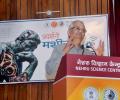
'Why should we disclose classified information to satisfy those who doubt our Hydrogen Bomb capability?'

'We need to find out whether any structural element has got fatigue.' 'We want to increase the lifespan of the bridge.'

The Vedica Scholars Programme for Women has helped many girls move up the ladder with a business education and liberal arts and find what they really want or are suited to do.

Assuming we still have a Modi-led majority government after May 2024, there is no guarantee that reforms will move at anything more than a snail's pace, though we must be thankful even for that, notes R Jagannathan.

Chairman Emeritus of the $100-billion Tata Sons, Ratan Tata, on Tuesday called for better co-operation and collaboration among sectors. He urged the government and industries to collaborate in a more proactive manner.

for the slight premium that you'll pay, the Tiago offers more safety tech, bigger engine, space and more creature comfort. Taking into the fact that the 1.0-litre Kwid is around the corner and will be considerably expensive in contrast to its 800cc counterpart, the Tiago makes an even stronger case for itself.

At least a dozen officers from Gujarat are handling key assignments in various important central positions
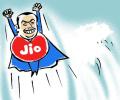
Billionaire Mukesh Ambani's Reliance Jio is India's strongest telecom brand in India, ahead of Bharti Airtel and Vodafone Idea Ltd, according to brand intelligence and data insights company TRA. TRA, formerly Trust Research Advisory, in its 'India's Most Desired Brands 2022' ranked companies according to their brand strength. Reliance Jio topped the telecom category, followed by Bharti Airtel, Vodafone Idea Ltd and BSNL.

India Inc very keen to do business in Gujarat.

With a net worth of $12.6 billion, Mistry is well known for constructing some of Mumbai's landmarks such as the Reserve Bank of India headquarters, The Taj Mahal Palace and Towers, and the Oberoi Hotels

'With free software on the Internet and apps, creating a deepfake video can take 3 to 5 minutes. Anyone can make these videos.'

Mistry is not the first Tata bigwig to be ousted and Tata is not the only big name which saw a doyen or two leave

Auto experts from CarJasoos will answer all your questions related to buying, selling or maintenance of new or used cars.
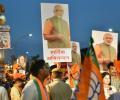
Donations received in form of electoral bonds were not included in the filing.

'Cyrus was always very different. He would think before acting.'

'We desire to see our children and children-in-law find legal acceptance for their relationship...' Chintan Girish Modi on how parents of LGBTQIA+ Indians have appealed to Chief Justice Chandrachud to 'consider the plea for marriage equality'.
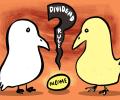
Corporate India continues to be generous in rewarding its shareholders with big dividend payouts. This is especially true for shareholders of companies such as Tata Consultancy Services (TCS), Hindustan Zinc (HZL), and Coal India (CIL) which are seen as cash cows of large business groups and the government. Boosted by a big payout by these three companies, the combined equity dividend payout by listed companies was up 38 per cent year-on-year (YoY) to a record high of Rs 2.27 trillion in 2022-23 (FY23), compared with Rs 1.65 trillion in 2021-22 (FY22).

The third phase of the construction of the Ram temple began at Ramjanmabhoomi in Ayodhya on January 24 with the laying of the granite stones for the plinth.

India's largest IT services player Tata Consultancy Services (TCS) saw its $2 billion, 10-year deal with Transamerica Life Insurance Company come to an end even before the period was over. Transamerica is the subsidiary of American arm of Dutch insurer Aegon NV. This is not the first time such a long-term deal has been called off. Earlier this year, UK's National Employment Savings Trust (NEST), ended a $1.8-billion deal with French IT services player Atos.
Tata and L&T's upcoming Dhamra Port is already taking away business.

Move follows Tata Steel decision to sell its loss-making businesses in Britain

The United Nations has dedicated a solidarity tree in remembrance of victims of terrorism with a solemn ceremony that also honoured victims of the 2008 Mumbai attack, on the eve of Prime Minister Narendra Modi's visit to the world organisation.

Mohammed Shami's participation in the upcoming Indian Premier League (IPL) will depend on the findings of the Board of Control for Cricket in India's (BCCI) Anti Corruption Unit (ACU) chief Neeraj Kumar, acting president CK Khanna said on Friday.

For FY14, the first full year of the law's implementation, the spend could go up to nearly Rs 8,700 crore (Rs 87 billion), given that India Inc's profitability has grown at a compounded 7.5 per cent annually in the past three years.

Tata Motors is giving a much stronger focus on the design of its cars, from planning product life cycle in a better way to incorporating subtle Indian elements to its future models.

Though Mistry does not make it to the club of the top 10 highest paid India Inc leaders, he will be among the next 10.

With cash shortage and plans going awry, the AirAsia owner is looking to cash out of the venture he built with Ratan Tata in 2013.

The central government has agreed in-principle to Air India employees' main demands. It fears an industrial dissension now could impede the process of privatisation. It has agreed to bear the cost of liquidation loss on account of transfer to the Employees' Provident Fund Organisation (EPFO) from company-owned trusts, inclusion of employees in the central government health scheme (CGHS), and encashment of leaves. The template of the Air India process will be followed for other public sector undertakings up for privatisation at a later date.

The global semiconductor shortage is turning into a headache for automotive (auto) and appliance manufacturers. But it is proving to be a boon for equity investors. Semiconductor stocks are among the best performers this year. The PHLX Semiconductor Index has gained more than 35 per cent year-to-date.
